Rabu, 27 Mei 2009


KISI-KISI ULUM Bil 7

MULTIPLE CHOICE
- Kind ofGoods Value
- Definition ofCapital production factors
- An extension effort of production
- Example of Direct distribution
- Definition ofWholeseller
- The factor which influences the consumption level
- The objective/purpose of performing a consumption activity
- The main purpose of a
- Definition of Cooperative
- One of matters that ought to be regarded before starting to be distributor
- Example of economic motive
- Example of mineral resource
- Manpower skill which is required in an economic activity
- Policy of Deandels
- Tarumanegara king was…
- The one that is not a factor that supported the development of Islam in
- One of the walisanga who used shadow puppet shows to spread Islam
- One method used by VOC to take control of a certain region was by creating conflicts among the parties existing in the area
- Effect from The fall of malaka into the hands of Portuguese people in 1511
- hasanudin and the Dutch agreement.
- The first Muslim king in Java
- The factor which made
- one that is the ways of spreading Islam to
- The one below that is not a role of the wali songo
- Science that learns weather specifically
- The tool to measure the direction and speed
- Volcanic lake definition
- Factor of
- Stalactite and stalagmite
- Definition of Infiltration
- One of these which is included in five farming method (panca usaha tani))
- Definition Thematic Map
- Definition Suggestive, Social contact, Sympathy, Identification
- Definition of Imitation, Autosuggestion, Sympathy, Identification
- The main and first place for place for a child to learn to socialize
- Example of repressive socialization in family
- Definition of balance, surplus and deficit
- The definition of hydrosphere
- Glacier river in
- The biggest quantity of gas in the
- Definition of Weather
- Ozone layer that filters ultraviolet located
- A negative effect of the geographical position of
- The effect of astronomical position of
- The objectives of mapping
- Definition of Inset, Legend, Orientation symbol, Map source
- Definition of Economic principle
- Definition of economic human
- The God of the Sun of Kutai people
- The leader of
KISI-KISI ULUM REGULER

- Arti dan ciri , PT, CV, Koperasi, Firma
- Kelemahan perusahaan persekutuan komanditer
- Pelakana kegiatan perusahaan dalam PT
- Kegiatan manusia yang palling banyak dilakukan oleh rumah tangga keluarga
- Hukum Gossen I dan II
- Cara meningkatkan jumlah dan kualitas hasil produksi
- Faktor produksi primer
- Keuntungan CV bagi sekutu pasif dan aktif
- Pengertian pedagang
- Faktor yang harus diperhatikan dalam menentukan sistem distribusi
- Arti Badan usaha
- Jenis produksi menurut jenis usaha
- Sunan yang menyebarkan Islam di daerah Jawa Barat, yaitu…..
- Contoh bentuk akulturasi budaya local dengan budaya islam
- Faktor-faktor penyebab datangnya bangsa Eropa ke Nusantara
- Pengaruh bangsa Portugis di Nusantara
- Bentuk politik balas budi
- Berikut adalah beberapa kebijakan Raffles di Indonesia
- Pengaruh budaya Eropa di Nusantaran
- Masuknya paham liberalisme dalam system ekonomi nusantara saat itu
- Contoh dari tindakan kreatif dalam ekonomi
- Salah satu sifat yang harus dikembangkan untuk membentuk jiwa kreatif
- Dampak dari dikuasainya selat Malaka oleh Portugis
- Contoh produksi ekstraktif
- Kerajaan yang berhubungan langsung dengan keberadaan wali songo
- Pengertian dan perbedaan antara badan usaha dengan perusahaan
- Macam-macam badan usaha
- Macam perusahaan dilihat dari lapangan atau bidang usahanya
- Sebutkan 5 dari 9 Wali yang menyebarkan agama islam di Nusantara
- Contoh pengaruh budaya Eropa di Indonesia
KISI-KISI ULUM AKSELERASI

KISI-KISI ULUM AKSELERASI
- Maksud kedatangan bangsa Portugis ke Indonesia
- Penyebab kegagalan Sultan Agung dalam melakukan penyerangan kedua ke Batavia
- Pencetus dan pelaksana sistem kerja paksa
- Perjanjian antara VOC dengan Sultan Hasanudin
- Bentuk politik etis
- Organisasi yang berhaluan radikal (non cooperation) melawan penjajahan Belanda
- Arti penting sumpah pemuda terhadap perjuangan mewujudkan Indonesia merdeka
- Factor utama yang mendorong pergerakan nasional di Indonesia
- Faktor ekstern yang membantu percepatan proses kemerdekaan Indonesia
- Tujuan pembentukan PETA
- bentuk propaganda antisekutu yang dilancarkan oleh Jepang
- Tokoh-tokoh yang memberikan masukan tentang dasar negara
- Organisasi buatan Jepang untuk persiapan menghadapi perang denga sekutu di Asia pasifik
- Presiden Republik Indonesia sementara
- 3 Sistem ekonomi dunia
- Kekurangan atau ciri negatif dari sistem ekonomi demokrasi
- Pengelompokan Benda menurut jumlah
- Tujuan dibentuknya badan usaha milik negara
- Peran pemerintah sebagai pengatur dalam bidang ekonomi
- Fungsi pasar
- Arti Monopoli
- Contoh pasar abstrak
- Peran BUMS dalam sistem demokrasi ekonomi
- Berikut BUMS yang memiliki tujuan untuk mencari keuntungan
- Arti Liberalisme , tradisional, Etatisme, Demokrasi ekonomi
ESSAY
- 4 faktor yang menyebabkan tumbuh dan berkembangnya rasa nasionalisme.
- Perbedaan perlawanan rakyat Indonesia terhadap penjajahan antara sebelum abad 20 dan setelah abad 20
- Pasar menurut persaingan
- Perbedaan antara tiga system ekonomi dunia
- Fungsi pasar dan jelaskan pengertiannya
Selasa, 26 Mei 2009
Atmosphere
An atmosphere (from Greek ατμός - atmos, 'vapor' + σφαίρα - sphaira, 'sphere') is a layer of gases that may surround a material body of sufficient mass,[1] by the gravity of the body, and are retained for a longer duration if gravity is high and the atmosphere's temperature is low. Some planets consist mainly of various gases, but only their outer layer is their atmosphere (see gas giants).
The term stellar atmosphere describes the outer region of a star, and typically includes the portion starting from the opaque photosphere outwards. Relatively low-temperature stars may form compound molecules in their outer atmosphere. Earth's atmosphere, which contains oxygen used by most organisms for respiration and carbon dioxide used by plants, algae and cyanobacteria for photosynthesis, also protects living organisms from genetic damage by solar ultraviolet radiation. Its current composition is the product of billions of years of biochemical modification of the paleoatmosphere by living organisms.
Atmospheric pressure is the force per unit area that is applied perpendicularly to a surface by the surrounding gas. It is determined by a planet's gravitational force in combination with the total mass of a column of air above a location. Units of air pressure are based on the internationally-recognized standard atmosphere (atm), which is defined as 101,325 Pa (or 1,013,250 dynes per cm²).
The pressure of an atmospheric gas decreases with altitude due to the diminishing mass of gas above each location. The height at which the pressure from an atmosphere declines by a factor of e (an irrational number with a value of 2.71828..) is called the scale height and is denoted by H. For an atmosphere with a uniform temperature, the scale height is proportional to the temperature and inversely proportional to the mean molecular mass of dry air times the planet's gravitational acceleration. For such a model atmosphere, the pressure declines exponentially with increasing altitude. However, atmospheres are not uniform in temperature, so the exact determination of the atmospheric pressure at any particular altitude is more complex.
Surface gravity, the force that holds down an atmosphere, differs significantly among the planets. For example, the large gravitational force of the giant planet Jupiter is able to retain light gases such as hydrogen and helium that escape from lower gravity objects. Second, the distance from the sun determines the energy available to heat atmospheric gas to the point where its molecules' thermal motion exceed the planet's escape velocity, the speed at which gas molecules overcome a planet's gravitational grasp. Thus, the distant and cold Titan, Triton, and Pluto are able to retain their atmospheres despite relatively low gravities. Interstellar planets, theoretically, may also retain thick atmospheres.
Since a gas at any particular temperature will have molecules moving at a wide range of velocities, there will almost always be some slow leakage of gas into space. Lighter molecules move faster than heavier ones with the same thermal kinetic energy, and so gases of low molecular weight are lost more rapidly than those of high molecular weight. It is thought that Venus and Mars may have both lost much of their water when, after being photodissociated into hydrogen and oxygen by solar ultraviolet, the hydrogen escaped. Earth's magnetic field helps to prevent this, as, normally, the solar wind would greatly enhance the escape of hydrogen. However, over the past 3 billion years the Earth may have lost gases through the magnetic polar regions due to auroral activity, including a net 2% of its atmospheric oxygen.[2]
Other mechanisms that can cause atmosphere depletion are solar wind-induced sputtering, impact erosion, weathering, and sequestration — sometimes referred to as "freezing out" — into the regolith and polar caps.
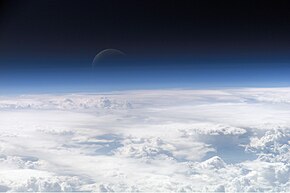

Initial atmospheric makeup is generally related to the chemistry and temperature of the local solar nebula during planetary formation and the subsequent escape of interior gases. These original atmospheres underwent much evolution over time, with the varying properties of each planet resulting in very different outcomes.
The atmospheres of the planets Venus and Mars are primarily composed of carbon dioxide, with small quantities of nitrogen, argon, oxygen and traces of other gases.
The atmospheric composition on Earth is largely governed by the by-products of the very life that it sustains. Earth's atmosphere contains roughly (by molar content/volume) 78.08% nitrogen, 20.95% oxygen, a variable amount (average around 0.247%, National Center for Atmospheric Research) water vapor, 0.93% argon, 0.038% carbon dioxide, and traces of hydrogen, helium, and other "noble" gases (and of volatile pollutants).
The low temperatures and higher gravity of the gas giants — Jupiter, Saturn, Uranus and Neptune — allows them to more readily retain gases with low molecular masses. These planets have hydrogen-helium atmospheres, with trace amounts of more complex compounds.
Two satellites of the outer planets possess non-negligible atmospheres: Titan, a moon of Saturn, and Triton, a moon of Neptune, which are mainly nitrogen. Pluto, in the nearer part of its orbit, has an atmosphere of nitrogen and methane similar to Triton's, but these gases are frozen when farther from the Sun.
Other bodies within the Solar System have extremely thin atmospheres not in equilibrium. These include the Moon (sodium gas), Mercury (sodium gas), Europa (oxygen), Io (sulfur), and Enceladus (water vapor).
The atmospheric composition of an extra-solar planet was first determined using the Hubble Space Telescope. Planet HD 209458b is a gas giant with a close orbit around a star in the constellation Pegasus. The atmosphere is heated to temperatures over 1,000 K, and is steadily escaping into space. Hydrogen, oxygen, carbon and sulfur have been detected in the planet's inflated atmosphere.[3]
The Earth's atmosphere consists, from the ground up, of the troposphere (which includes the planetary boundary layer or peplosphere as lowest layer), stratosphere, mesosphere, thermosphere (which contains the ionosphere and exosphere) and also the magnetosphere. Each of the layers has a different lapse rate, defining the rate of change in temperature with height.
Three quarters of the atmosphere lies within the troposphere, and the depth of this layer varies between 17 km at the equator and 7 km at the poles. The ozone layer, which absorbs ultraviolet energy from the Sun, is located primarily in the stratosphere, at altitudes of 15 to 35 km. The Kármán line, located within the thermosphere at an altitude of 100 km, is commonly used to define the boundary between the Earth's atmosphere and outer space. However, the exosphere can extend from 500 up to 10,000 km above the surface, where it interacts with the planet's magnetosphere.
http://en.wikipedia.org/wiki/Atmosphere
THE FORMING OF SURFACE OF EARTH
At the end of the chapter, students should be able to :
1. Explain how landform are a result if internal forces of crustal movement
2. Describe how landform are modified by external forces
3. Discuss how landform affect people
THE FORMING OF SURFACE OF EARTH
A. Endogenic
its  resulting features such as a rock that originated within the earth
Endogenic power consist of :
The movement of plates which make up the earth’s crust. We call the tectonic is movement plates. The movement is very slowly-between 1 – 5 centimetres per year- so we do not feel the movement.
( The mantle made of liquid rock that flows in certain directions due to convection currents. Movement of the mantle cause the crustel paltes that lie on to move )
Kind of tectonic or movement plates is :
a. Fault
Is a fracture in rock along which the adjacent rock surfaces are differentially displace
-or-
plates slide past each other along the cracks of the earth crust
As the plates move, they may
- Slide past
- Pull a part
- Push toward each other
“When plates move a part, the molten mantle beneath the earth’s crust will rise up to create new landform like volcanoes”
“When plates push towards each other, mountains and volcanoes may be formed”
Fault consist of :
- Graben Fault is up displace
- Horst Fault is down displace
- Compiling Fault is two or more displace / fault compailing
b. Folding
When two plates collide with each other, some of the layers of rock which make up the earth’s crust buckle and form fold
or
a bend in rock strata or other planar structure, usually produced by deformation and recognized where layered rock have been distroyed into wavelike form
Demontrate with cardboard !!
(The amount of folding that takes place can be so small that is hardly noticeable, or it can be so large that mountain are formed as a result
these mountain are called fold mountain)
Example,
Fold mountain is Himalayas in
Mount Everest are located in the
Himlayas were first formed around 40 – 50 million years ago and they are still growing today.
Why ?
Because the
2. Vulcanicity
Process magma pushes its way into crust of the earth and reaches the earth surface through cracks which are often found along boundaries of plate.
Lava is when magma reaches the earth’s surface
Eruption is process of outpouring the lava to earth’s surface
Volcano is process of magma escapes to the earth’s surface through a single hole and hardened lava built up from many eruptions results in a cone shaped mountain
“Volcanoes have the same basic structure but their shapes and sizes are possible reasons for different, Why ?
Because depend of
1. Rate of flow
2. Compotition of lava”
( Open Chapter of Volcanicity )