Tampilkan postingan dengan label geografi bilingual. Tampilkan semua postingan

Selasa, 26 Mei 2009

Atmosphere

An atmosphere (from Greek ατμός - atmos, 'vapor' + σφαίρα - sphaira, 'sphere') is a layer of gases that may surround a material body of sufficient mass,[1] by the gravity of the body, and are retained for a longer duration if gravity is high and the atmosphere's temperature is low. Some planets consist mainly of various gases, but only their outer layer is their atmosphere (see gas giants).

The term stellar atmosphere describes the outer region of a star, and typically includes the portion starting from the opaque photosphere outwards. Relatively low-temperature stars may form compound molecules in their outer atmosphere. Earth's atmosphere, which contains oxygen used by most organisms for respiration and carbon dioxide used by plants, algae and cyanobacteria for photosynthesis, also protects living organisms from genetic damage by solar ultraviolet radiation. Its current composition is the product of billions of years of biochemical modification of the paleoatmosphere by living organisms.

Atmospheric pressure is the force per unit area that is applied perpendicularly to a surface by the surrounding gas. It is determined by a planet's gravitational force in combination with the total mass of a column of air above a location. Units of air pressure are based on the internationally-recognized standard atmosphere (atm), which is defined as 101,325 Pa (or 1,013,250 dynes per cm²).

The pressure of an atmospheric gas decreases with altitude due to the diminishing mass of gas above each location. The height at which the pressure from an atmosphere declines by a factor of e (an irrational number with a value of 2.71828..) is called the scale height and is denoted by H. For an atmosphere with a uniform temperature, the scale height is proportional to the temperature and inversely proportional to the mean molecular mass of dry air times the planet's gravitational acceleration. For such a model atmosphere, the pressure declines exponentially with increasing altitude. However, atmospheres are not uniform in temperature, so the exact determination of the atmospheric pressure at any particular altitude is more complex.

Surface gravity, the force that holds down an atmosphere, differs significantly among the planets. For example, the large gravitational force of the giant planet Jupiter is able to retain light gases such as hydrogen and helium that escape from lower gravity objects. Second, the distance from the sun determines the energy available to heat atmospheric gas to the point where its molecules' thermal motion exceed the planet's escape velocity, the speed at which gas molecules overcome a planet's gravitational grasp. Thus, the distant and cold Titan, Triton, and Pluto are able to retain their atmospheres despite relatively low gravities. Interstellar planets, theoretically, may also retain thick atmospheres.

Since a gas at any particular temperature will have molecules moving at a wide range of velocities, there will almost always be some slow leakage of gas into space. Lighter molecules move faster than heavier ones with the same thermal kinetic energy, and so gases of low molecular weight are lost more rapidly than those of high molecular weight. It is thought that Venus and Mars may have both lost much of their water when, after being photodissociated into hydrogen and oxygen by solar ultraviolet, the hydrogen escaped. Earth's magnetic field helps to prevent this, as, normally, the solar wind would greatly enhance the escape of hydrogen. However, over the past 3 billion years the Earth may have lost gases through the magnetic polar regions due to auroral activity, including a net 2% of its atmospheric oxygen.[2]

Other mechanisms that can cause atmosphere depletion are solar wind-induced sputtering, impact erosion, weathering, and sequestration — sometimes referred to as "freezing out" — into the regolith and polar caps.
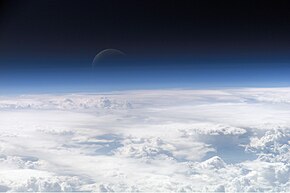
Atmospheric gases scatter blue light more than other wavelengths, giving the Earth a blue halo when seen from space.

Initial atmospheric makeup is generally related to the chemistry and temperature of the local solar nebula during planetary formation and the subsequent escape of interior gases. These original atmospheres underwent much evolution over time, with the varying properties of each planet resulting in very different outcomes.

The atmospheres of the planets Venus and Mars are primarily composed of carbon dioxide, with small quantities of nitrogen, argon, oxygen and traces of other gases.

The atmospheric composition on Earth is largely governed by the by-products of the very life that it sustains. Earth's atmosphere contains roughly (by molar content/volume) 78.08% nitrogen, 20.95% oxygen, a variable amount (average around 0.247%, National Center for Atmospheric Research) water vapor, 0.93% argon, 0.038% carbon dioxide, and traces of hydrogen, helium, and other "noble" gases (and of volatile pollutants).

The low temperatures and higher gravity of the gas giants — Jupiter, Saturn, Uranus and Neptune — allows them to more readily retain gases with low molecular masses. These planets have hydrogen-helium atmospheres, with trace amounts of more complex compounds.

Two satellites of the outer planets possess non-negligible atmospheres: Titan, a moon of Saturn, and Triton, a moon of Neptune, which are mainly nitrogen. Pluto, in the nearer part of its orbit, has an atmosphere of nitrogen and methane similar to Triton's, but these gases are frozen when farther from the Sun.

Other bodies within the Solar System have extremely thin atmospheres not in equilibrium. These include the Moon (sodium gas), Mercury (sodium gas), Europa (oxygen), Io (sulfur), and Enceladus (water vapor).

The atmospheric composition of an extra-solar planet was first determined using the Hubble Space Telescope. Planet HD 209458b is a gas giant with a close orbit around a star in the constellation Pegasus. The atmosphere is heated to temperatures over 1,000 K, and is steadily escaping into space. Hydrogen, oxygen, carbon and sulfur have been detected in the planet's inflated atmosphere.[3]

The Earth's atmosphere consists, from the ground up, of the troposphere (which includes the planetary boundary layer or peplosphere as lowest layer), stratosphere, mesosphere, thermosphere (which contains the ionosphere and exosphere) and also the magnetosphere. Each of the layers has a different lapse rate, defining the rate of change in temperature with height.

Three quarters of the atmosphere lies within the troposphere, and the depth of this layer varies between 17 km at the equator and 7 km at the poles. The ozone layer, which absorbs ultraviolet energy from the Sun, is located primarily in the stratosphere, at altitudes of 15 to 35 km. The Kármán line, located within the thermosphere at an altitude of 100 km, is commonly used to define the boundary between the Earth's atmosphere and outer space. However, the exosphere can extend from 500 up to 10,000 km above the surface, where it interacts with the planet's magnetosphere.

http://en.wikipedia.org/wiki/Atmosphere

THE FORMING OF SURFACE OF EARTH


At the end of the chapter, students should be able to :

1. Explain how landform are a result if internal forces of crustal movement

2. Describe how landform are modified by external forces

3. Discuss how landform affect people


THE FORMING OF SURFACE OF EARTH

A. Endogenic

its resulting features such as a rock that originated within the earth

Endogenic power consist of :

1. Tectonic

The movement of plates which make up the earth’s crust. We call the tectonic is movement plates. The movement is very slowly-between 1 – 5 centimetres per year- so we do not feel the movement.

( The mantle made of liquid rock that flows in certain directions due to convection currents. Movement of the mantle cause the crustel paltes that lie on to move )

Kind of tectonic or movement plates is :

a. Fault

Is a fracture in rock along which the adjacent rock surfaces are differentially displace

-or-

plates slide past each other along the cracks of the earth crust

As the plates move, they may

- Slide past

- Pull a part

- Push toward each other

“When plates move a part, the molten mantle beneath the earth’s crust will rise up to create new landform like volcanoes”

“When plates push towards each other, mountains and volcanoes may be formed”

Fault consist of :

  1. Graben Fault is up displace
  2. Horst Fault is down displace
  3. Compiling Fault is two or more displace / fault compailing

b. Folding

When two plates collide with each other, some of the layers of rock which make up the earth’s crust buckle and form fold

or

a bend in rock strata or other planar structure, usually produced by deformation and recognized where layered rock have been distroyed into wavelike form

Demontrate with cardboard !!

(The amount of folding that takes place can be so small that is hardly noticeable, or it can be so large that mountain are formed as a result

these mountain are called fold mountain)

Example,

Fold mountain is Himalayas in Nepal.

Mount Everest are located in the Himalayas.

Himlayas were first formed around 40 – 50 million years ago and they are still growing today.

Why ?

Because the Himalayas are located along two plates (indoaustralian and Eurasian plates and that still pushing againt each other


2. Vulcanicity

Process magma pushes its way into crust of the earth and reaches the earth surface through cracks which are often found along boundaries of plate.

Lava is when magma reaches the earth’s surface

Eruption is process of outpouring the lava to earth’s surface

Volcano is process of magma escapes to the earth’s surface through a single hole and hardened lava built up from many eruptions results in a cone shaped mountain

“Volcanoes have the same basic structure but their shapes and sizes are possible reasons for different, Why ?

Because depend of

1. Rate of flow

2. Compotition of lava”

( Open Chapter of Volcanicity )

THE INTERNAL STRUCTURE OF THE EARTH


THE INTERNAL STRUCTURE OF THE EARTH

At the end of the chapter, students should be able to :

1. Describe the different types of landform

2. Describe the layers of the earth

TASK :

Describe the characteristics of the type of landform!


LAYERS OF THE EARTH

  1. The Core

The core is the centre of Earth. Temperatures here can be as high as 5.000 degree celcius. Interestingly, although the temperatures are high, the innermost part of the core is solid. It is because of the great pressure and weight exerted on the core by the outer layers of the earth.

  1. The Mantle

The mantle is almost 2.900 km thick and makes up nearly 80 percent of the earth total volume. The temperatures in this layer reach more than 2.000 degrees celcius and the upper part of this layer is often is a semi molten or semi liquid state.

  1. The Crust

The crust is the outermost layer of the earth. It is solid and varies in thickness from 6 – 70 km. the earth’s crust is not continous layer but is made up of many separate pieces called plate. The plates float on the semi molten mantle beneath them. They are of different sizes and they seem to fit together like a jigsaw puzzle.

“According to scientist, the plates originally formed one gigantic piece of land, or supercontinent, called pangaea. Over million of years, the plates separated and moved to become the pieces of land that we see today.”

“Plural of the plateau is plateaux”

LANDFORM


At the end of the chapter, students should be able to :

  • Explain the interrelationships between the components of the physical environment

LANDFORM

The earth have a four component :

1. The atmosphere is the layer of air that surrounds the earth

2. The lithosphere consist of landform and rocks found on the earth

3. The biosphere is made up of the living environment

4. The hydrosphere is made up of rivers, lakes and oceans


TYPES OF LANDFORM

Landform and rocks are created and changed by processes beneath and on the earth surface, consist of :

1. Rivers are streams which flow from high ground to low ground include waterfalls and deltas.

2. Mountain is an area of high ground, usually more than 600 metres high. It often has step slopes and a narrow top or peak. Where a few mountains are located close together, they form a mountain range.

3. Hill Is an area of high ground, usually less than 600 metres high. It is typically rounded in shape and has gentle slopes

4. Plain is a broad, flat and low area on the earth surface

5. Plateau is generally a raised area of land with a fairly flat, broad top and steep slopes

Is land formed when a large quantity of magma escapes from a long crack or fault in the earth’s crust and spreads over a very large area

this lava then solidifies on the earth’s surface, and after numerous eruption, these layers of hardened lava result in a plateu. We can found in iceland and greenland

famous and highest plateux in the earth’s are Tibetan Plateau in Tibet

another plateaux is :

1. Colorado Plateau in USA

2. Giza Plateau in Agypth

WHAT IS GEOGRAPHY ?

  • At the end of the chapter, student should be able to :
  1. Understand the importance of studying geography
  2. Understand the physical-human realtionship in geography
  3. Understand the value of fieldwork in geography

WHAT IS GEOGRAPHY ?

“GEOGRAPHY” COMES FROM THE ANCIENT GREEK WORDS

“GEO” MEANING “EARTH”

AND

“GRAPHIEN” MEANING “TO WRITE”.

OR

“TO WRITE ABOUT, OR DESCRIBE THE EARTH”

( Geography is much more than just identifying the capital cities or locating countries on the map. Geography encompasses the study of places, environment and features on the earth’s surface. It examines the natural processes at work and the relationship between people and the environment. Geography help us to better understand and appreciate the world we live in or study of the environment that we live )


Task :

Mention the place or country that you would like to travel to and explain to us why you chose the destination !


WHEN WE STUDY GEOGRAPHY, WE ARE INTERESTED IN OUR ENVIRONMENT. THE ENVIRONMENT THAT WE LIVE CAN BE DIVIDED INTO THE PHYSICAL AND THE HUMAN ENVIRONMENT.


( The physical environment refers to the earth’s physical features and the processes leading to their formation. Physical features are things that occur naturally on the earth, such mountains and volcanoes. They axist in nature and cannot be created by people. Examples of physical features that we will learn about are rocks and different types of natural vegatation )

and

( The Human environment describes the way people live, work and interact with the physical environment. For example, we will learn where people live, the types of housing people live in and what people do )

Task :

  1. Discuss how the earth’s physical features and the processes and the processes leading to their formation can affect humans both positively and negatively.
  2. Why human activities must change the physical environment and what negatively for our live ?

As we study geography, we will come to understand how the earth’s physical features and the processes that shape them have an influence on human lives. For example, people usually build their homes in places where there is abundant fresh water and where it is possible to grow crops. Natural disasters such as hurricanes and earthquakes affect people negatively because than can distroy lives and property.


WHY DO WE STUDY GEOGRAPHY ?

it is natural for us to know more about our environment and the world we live in. the knowledge that we gain will help us to better understand the world arround us

geography helps us realise that there is a relationship between people, plant and animals because we all share one home -the earth

Develops skill in locating and acquiring information, critical thinking and decision making. example, we learn map reading skills to locate cities and analyse pattern of land use as well as change made to the environment.